
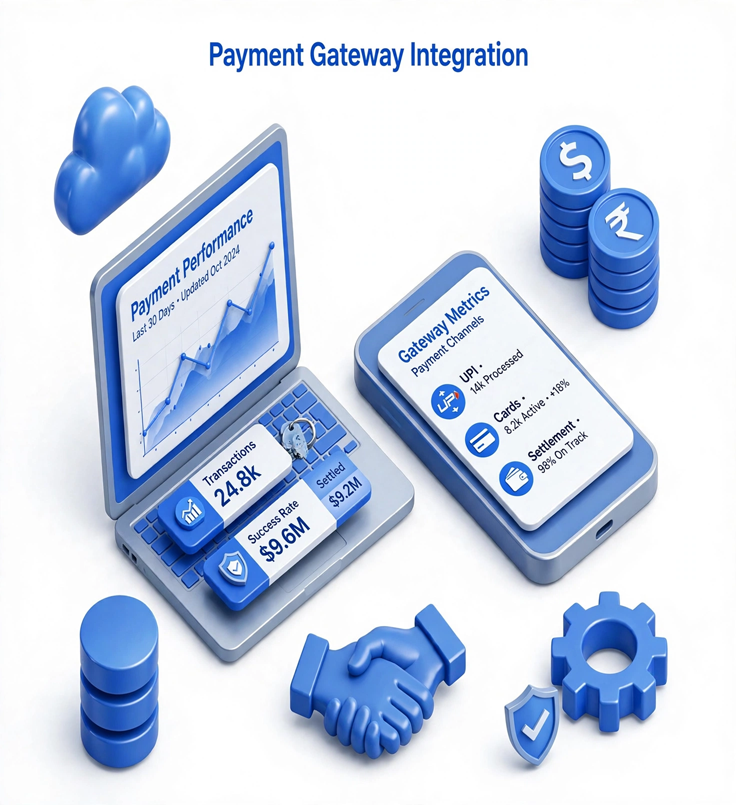
Payment Gateway Integration

Home > Payment Gateway Integration

Turn Online Payments Into a Connected Part of Your Business

A successful online payment is more than money moving from a customer to a business. Your website or application also needs to know who paid, what they paid for, how much was received, whether the transaction is genuinely successful, and what should happen next.

Tamtech Technology provides Payment Gateway Integration Services that connect online payment systems with websites, mobile applications and business software. We build payment workflows that can communicate with your order management, billing, subscription, membership, accounting or other application modules.

Whether you are adding payments to an existing platform or developing a new digital product, our team can create an integration based on your technology stack and operational requirements.

Our Payment Gateway API Integration approach focuses on transaction creation, payment response handling, verification, callbacks, webhooks and application-side status updates.

What Does Payment Gateway Integration Mean?

Payment Gateway Integration connects a digital platform with a payment service so customers can initiate and complete online transactions from the business's website, application or software.

The integration acts as a communication layer between your application and the payment provider.

A typical transaction may follow this sequence:

Customer
Payment Request
Gateway Checkout
Payment Processing
Transaction Confirmation
Verification
Business Software Update

For example, suppose a customer purchases a service through your website. Once the payment is completed, your system should not merely display a "Payment Successful" message. It should also be able to identify the transaction, verify the result and update the relevant order or customer record.

That connection between the payment event and your business process is where professional integration becomes important.

Payment Gateway Integration for Websites, Apps & Software

Different businesses have different payment requirements. A simple service website may only need a payment page, while an enterprise application may need payment processing connected to orders, invoices, customer accounts and reporting.

Tamtech Technology develops payment integrations for:

  • Business websites
  • eCommerce platforms
  • Custom web applications
  • Android applications
  • iOS applications
  • SaaS platforms
  • ERP systems
  • CRM applications
  • Billing software
  • Subscription platforms
  • Membership portals
  • Booking systems
  • Education platforms
  • Financial applications
  • Custom enterprise software

The implementation is planned around the payment provider's available APIs, SDKs and integration methods.

Our Payment Gateway API Integration Services

API-Based Payment Integration

Our Payment Gateway API Integration service allows your application to communicate with the selected payment provider programmatically.

Depending on the gateway's capabilities, an integration may include:

  • Payment/order creation
  • Transaction reference generation
  • Customer information transfer
  • Amount calculation
  • Checkout initiation
  • Payment response processing
  • Transaction verification
  • Status enquiry
  • Callback handling
  • Webhook processing
  • Refund-related workflows
  • Application database updates

The objective is to make the payment process part of your application's normal operating workflow rather than maintaining it as a disconnected external activity.

Website Payment Integration

If you already have a website and want to start accepting online payments, Tamtech Technology can integrate the selected gateway into your existing platform.

The payment workflow can be connected with:

  • Shopping carts
  • Product orders
  • Service bookings
  • Customer registration
  • Application forms
  • Membership fees
  • Invoice payments
  • Event registrations
  • Account recharge
  • Subscription purchases

The implementation can be adapted to your existing website architecture instead of requiring you to rebuild the entire platform.

Mobile Application Payment Integration

Mobile users expect a straightforward payment experience. We can integrate supported payment APIs or SDKs into mobile applications according to the payment provider's technical requirements.

Possible use cases include:

  • In-app purchases
  • Service payments
  • Subscription charges
  • Booking payments
  • Membership renewals
  • Digital services
  • Account top-ups
  • Installment or bill payments

The application can also communicate transaction information back to your server so that payment records remain synchronized with your central database.

Payment Methods Through Gateway Integration

The actual payment methods available depend on the payment provider, merchant configuration and applicable eligibility requirements.

A suitable gateway may allow businesses to offer combinations of:

UPI Payments

Provide customers with supported UPI payment options within the checkout experience.

Debit & Credit Cards

Accept eligible card payments through the payment provider's supported checkout mechanism.

Net Banking

Allow customers to use supported banking options where available.

Wallets

Integrate supported digital wallet payment methods when offered by the selected provider.

Other Supported Methods

Depending on the gateway, additional payment methods may be available for particular merchants or transaction types.

Tamtech Technology can structure the application so the available payment methods are presented according to the provider's integration capabilities.

Connecting Payments With Your Business Software

The biggest advantage of a properly designed payment integration is the ability to connect the transaction with the rest of your software.

01
Payment + Order Management

Once a verified payment is received, your system can update the associated order and continue the relevant fulfilment process.

02
Payment + Billing

Payment information can be connected with invoices and billing records so that your internal system can reflect the appropriate transaction status.

03
Payment + CRM

Customer payment activity can be associated with the relevant customer account within your CRM.

04
Payment + ERP

Businesses can connect payment information with broader financial or operational workflows within an ERP system.

05
Payment + Subscription

Subscription platforms can use payment events to manage activation, renewal and account status according to their business rules.

06
Payment + Membership

Membership portals can associate successful transactions with registration, renewal or applicable membership services.

Transaction Verification Is a Critical Part of Integration

A payment redirect or browser response should not automatically be considered proof that a transaction has been successfully completed.

A properly designed payment workflow can include an additional verification step using the mechanisms supported by the payment provider.

This helps your application distinguish between different transaction outcomes.

For example:

Payment Initiated
Customer Attempts Payment
Gateway Processes Transaction
Application Receives Response
Transaction Verified
Record Updated

This approach reduces the risk of incorrectly marking an order, invoice or account as paid based solely on an unverified client-side response.

Callback & Webhook Integration

Modern payment systems can provide transaction notifications through callbacks or webhooks.

These mechanisms allow the payment provider to communicate transaction-related information back to your application.

Tamtech Technology can implement appropriate callback and webhook handling so your software can process relevant payment events.

Depending on the provider and business workflow, this can help with:

  • Payment status synchronization
  • Delayed transaction updates
  • Order status changes
  • Invoice updates
  • Subscription events
  • Payment reconciliation
  • Transaction tracking

Webhook processing should also be designed to handle repeated notifications safely so that the same transaction does not accidentally create duplicate business records.

Payment Status Management

Real-world payment processing does not always result in a simple success/failure outcome.

Your application may need to recognize states such as:

  • Initiated
  • Processing
  • Successful
  • Failed
  • Pending
  • Cancelled
  • Expired
  • Refunded

The exact terminology and available transaction states vary between payment providers.

We can structure your application logic around the relevant status model so that each transaction state produces the appropriate business action.

Payment Reconciliation & Transaction Tracking

For businesses handling regular online payments, transaction tracking becomes increasingly important as transaction volume grows.

A payment integration can be designed to retain useful references such as:

  • Internal order number
  • Gateway transaction ID
  • Payment amount
  • Customer reference
  • Transaction date
  • Payment status
  • Gateway response information
  • Refund information where applicable

This information can make it easier for your team to investigate transactions and compare application records with payment-provider reports.

Security-Focused Payment Integration

Payment systems handle financially important transactions, so integration should be developed with appropriate security practices.

Our implementation approach can include:

  • Secure server-side communication
  • Protected API credentials
  • HTTPS-based communication
  • Input validation
  • Transaction reference controls
  • Server-side verification
  • Secure webhook processing
  • Appropriate error handling
  • Restricted access to sensitive configuration
  • Prevention of duplicate transaction processing

The exact security architecture depends on your application and the payment provider's technical requirements.

Tamtech Technology does not treat payment integration as simply a frontend development task. The server-side transaction lifecycle is equally important.

Multiple Payment Gateway Integration

Some businesses may prefer to work with more than one payment provider.

Multiple gateway support can be useful when a business needs:

  • Alternative payment infrastructure
  • Different payment capabilities
  • Provider-specific payment methods
  • Business continuity options
  • Separate payment flows for different products
  • Integration with different business units

Tamtech Technology can develop an architecture capable of communicating with multiple gateways when the business requirement justifies it.

Our Payment Integration Development Process

01
Requirement Analysis

We understand your application, customer journey, payment requirement and existing database structure.

02
Gateway Documentation Review

We examine the selected provider's API documentation, authentication mechanism, transaction process and supported integration methods.

03
Payment Flow Planning

We define how a transaction should move from your application to the payment provider and back into your system.

04
API Development

The required payment APIs, SDKs, callbacks, webhooks and verification mechanisms are implemented.

05
Business-System Mapping

Payment results are mapped to the relevant order, invoice, customer, subscription or account records.

06
Transaction Testing

We test different transaction outcomes, including successful, failed and pending scenarios where supported.

07
Production Configuration

After testing, the integration is configured for the production environment using the merchant credentials and settings supplied by the payment provider.

08
Post-Integration Support

We can assist with integration troubleshooting, technical changes and maintenance requirements after deployment.

Why Businesses Choose Tamtech Technology

Technology + Business Understanding

We consider both the API requirements and the business process behind the transaction.

Custom Development

Your payment workflow can be designed around your existing application rather than forcing your business process into a generic template.

Existing Software Integration

We can work with existing websites and software systems where the technical architecture permits integration.

Scalable Architecture

Payment functionality can be structured so that your application remains ready for future feature expansion.

Transaction-Centric Approach

We pay attention to transaction references, verification, status changes and database synchronization.

Practical Implementation

Our objective is to deliver a payment workflow that fits the way your business actually operates.

Who Can Benefit From Payment Gateway Integration?

Our Payment Gateway Integration Services can be useful for:

  • Startups launching digital platforms
  • eCommerce businesses
  • Software companies
  • SaaS providers
  • Educational organizations
  • Membership-based businesses
  • Service providers
  • Booking platforms
  • Financial software providers
  • Healthcare platforms
  • ERP solution providers
  • CRM solution providers
  • Enterprises with custom software

If your customers need to pay online and your software needs to recognize and process those payments, a properly planned gateway integration can become an important part of your digital infrastructure.

Build a Payment Workflow Around Your Application

Online payment functionality should not end at the checkout screen.

The real value comes when a verified transaction automatically becomes meaningful information inside your business system—an order is updated, an invoice is recorded, a subscription is activated, or a customer account reflects the appropriate payment status.

The real value comes when a verified transaction automatically becomes meaningful information inside your business system—an order is updated, an invoice is recorded, a subscription is activated, or a customer account reflects the appropriate payment status.

Whether you are adding payments to an existing website or building a new software platform, we can help you plan and implement an integration suited to your technical and business requirements.

Start Your Payment Gateway Integration Project

Looking to add online payments to your website, mobile application or custom software?

Talk to Tamtech Technology about your Payment Gateway Integration requirements and build a payment workflow that works with your business—not around it.

Frequently Asked Questions

Payment Gateway Integration is the technical connection between a website, mobile application or software system and a payment provider that enables online transactions and allows the application to receive and process transaction information.

Payment Gateway API Integration uses application programming interfaces provided by a payment service to exchange transaction-related information between your software and the payment provider.

Yes. We can integrate a suitable payment gateway into an existing website or web application, subject to the platform's technical architecture and the payment provider's integration requirements.

Yes. Payment gateways can be integrated into mobile applications using supported APIs, SDKs or other integration approaches offered by the selected provider.

Yes. Where the application and gateway support the required workflow, verified payment information can be connected with ERP, CRM, billing, accounting, subscription or other business modules.

Yes. UPI can be offered through payment providers that support the required UPI integration method. Availability depends on the provider, merchant configuration and applicable requirements.

The verification process depends on the payment provider. An application may use server-side APIs, callbacks, webhooks or other mechanisms supplied by the provider to confirm the transaction before updating the business record.

Yes. Where there is a business requirement, software can be designed to communicate with multiple payment providers.

Yes. Tamtech Technology provides customized integration for websites, mobile applications, SaaS platforms and business software according to the application's workflow and selected gateway.

The cost depends on the payment provider, application platform, number of payment workflows, API complexity, required transaction handling and the level of customization involved. A requirement-based assessment is needed for an accurate estimate.
Book Demo