
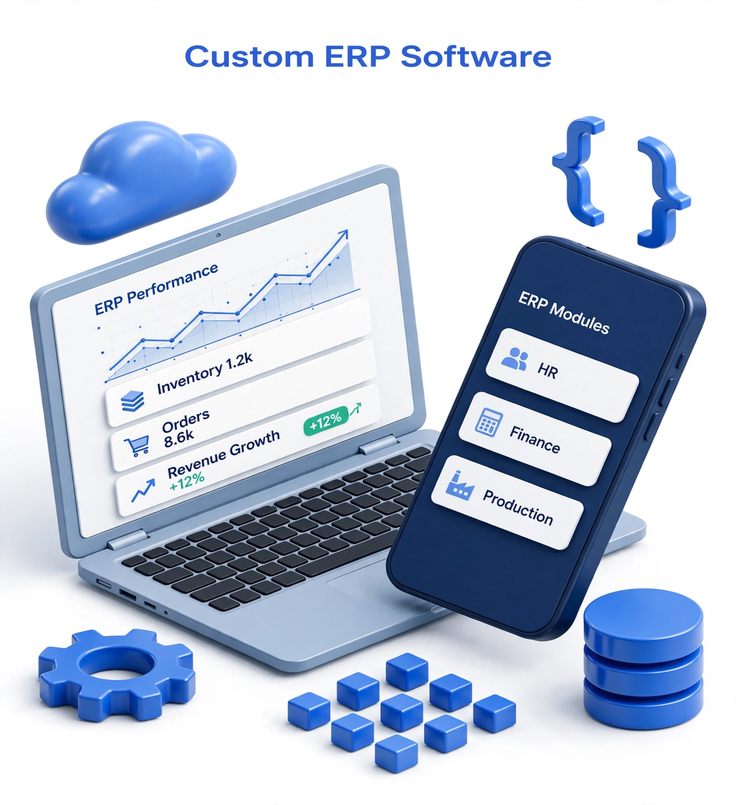
Custom ERP Software

Home > Custom ERP Software Development

Custom ERP Software Development for Modern Businesses

As businesses grow, managing sales, purchases, inventory, accounts, employees, customers, operations, and management reporting through separate applications can create unnecessary complexity. Data may be duplicated across departments, reports may take longer to prepare, and management may not have a single view of business operations.

Tamtech Technology provides Custom ERP Software Development services to help businesses bring their core operations into one integrated software environment. Instead of forcing an organization to change its workflow to match a standard application, a custom ERP can be designed around the company's actual processes, departments, approval systems, reporting requirements, and future growth plans.

Best ERP Software Kolkata

Businesses searching for the Best ERP Software Kolkata often need more than an accounting or inventory application. A complete ERP should connect different departments and allow information to move between them without unnecessary duplicate data entry.

Tamtech Technology develops configurable ERP solutions for businesses in Kolkata and across India.

Depending on business requirements, an ERP platform can include:

  • • Customer Management
  • CRM
  • Sales Management
  • Purchase Management
  • Inventory
  • Billing
  • Accounting
  • HR & Payroll
  • Expense Management
  • Vendor Management
  • Service Management
  • Collection Management
  • Loan Management
  • Branch Management
  • Management Reports

The modules can operate independently or share data through an integrated database and application workflow.

Best ERP Software India

Organizations looking for the Best ERP Software India should evaluate more than the number of modules offered by a software provider.

Important considerations include:

  • • Business process compatibility
  • Customization capability
  • Integration options
  • Data security
  • Scalability
  • Reporting
  • User permissions
  • Mobile accessibility
  • Multi-branch support
  • Implementation and support

Tamtech Technology focuses on developing ERP systems according to the operational structure of the organization.

The objective is to create one connected business environment where authorized employees can access the information required for their responsibilities.

What is Custom ERP Software Development?

Custom ERP Software Development involves designing and developing an enterprise resource planning system specifically around an organization's operational requirements.

A typical development process can include:

Requirement Analysis
Process Mapping
ERP Architecture
Module Development
Integration
Testing
Deployment
Training
Support

This approach allows the software to reflect the organization's actual business rules instead of relying entirely on predefined workflows.

Business Process Automation

One of the primary purposes of ERP software is to reduce repetitive manual activities.

For example, a sales transaction can automatically connect different business processes:

Customer
Quotation
Sales Order
Invoice
Payment
Accounting

Similarly, procurement can follow:

Purchase Request
Purchase Order
Supplier
Goods Receipt
Purchase Invoice
Payment

Custom ERP Modules

An ERP platform can be developed using individual modules according to the organization's requirements.

01
CRM & Lead Management

Manage prospects, customers, sales opportunities, follow-ups, communication, and customer history.

02
Sales Management

Manage quotations, orders, invoices, sales targets, sales executives, and sales reports.

03
Purchase Management

Manage suppliers, purchase requests, purchase orders, goods received, invoices, and supplier payments.

04
Inventory Management

Track products, stock levels, warehouses, stock movements, purchases, sales, and adjustments.

05
Billing & Accounting

Manage invoices, receipts, expenses, ledgers, vouchers, receivables, payables, and financial reports.

06
HR & Payroll

Maintain employee information, attendance, leave, salary structures, payroll, payslips, and HR reports.

07
Collection Management

Manage customer dues, collection assignments, field executives, payments, receipts, overdue accounts, and collection reporting.

08
Loan Management

For financial organizations, ERP can be connected with loan processing, repayment schedules, EMI collection, customer accounts, and financial transactions.

08
ERP for Multiple Branches

Businesses operating through multiple branches need centralized control without compromising branch-level operations.

A custom ERP can provide branch-based access and reporting.

Management can view consolidated information while branch users can work with the customers, transactions, employees, and activities assigned to their location.

Branch-wise reports can include:

  • Sales
  • Purchases
  • Expenses
  • Collections
  • Inventory
  • Employees
  • Customers
  • Receivables
  • Payables

Role-Based Access Control

Different departments should not necessarily have access to the same information.

A custom ERP can provide role-based permissions for:

  • Administrator
  • Management
  • Accounts
  • Sales
  • Purchase
  • Inventory
  • HR
  • Branch Manager
  • Field Executive
  • Customer Support

Permissions can control whether a user can view, create, edit, approve, delete, or export specific information.

ERP Dashboard & MIS Reporting

Management needs actionable information rather than manually prepared spreadsheets.

An ERP dashboard can display important business indicators such as:

  • Sales
  • Purchases
  • Revenue
  • Expenses
  • Receivables
  • Payables
  • Inventory
  • Collection
  • Employee information
  • Branch performance

Customized MIS reports can be developed according to the organization's KPIs.

ERP Integration with Existing Software

A company does not always need to replace every existing application.

Custom ERP development can include API-based integration with existing systems such as:

  • Payment gateways
  • Banking services
  • GST-related applications
  • CRM
  • Accounting software
  • Payroll systems
  • SMS platforms
  • WhatsApp Business services
  • Email services
  • Biometric attendance
  • E-commerce platforms
  • Third-party APIs

Integration allows existing technology investments to remain part of the broader business ecosystem where appropriate.

Mobile ERP Application

Managers and field employees may require access outside the office.

A mobile ERP application can provide selected functionality such as:

  • Customer information
  • Sales activities
  • Collection
  • Attendance
  • Approvals
  • Tasks
  • Notifications
  • Reports

Mobile functionality can be designed according to employee roles rather than exposing the complete ERP database through a mobile application.

Cloud-Based ERP

Cloud deployment allows authorized users to access the ERP system from different locations, subject to the organization's security and hosting architecture.

This can be useful for:

  • Multi-branch companies
  • Remote teams
  • Field operations
  • Head offices
  • Distributed management

A production ERP environment should include appropriate authentication, access control, database backup, monitoring, and security measures.

Custom Workflow & Approval System

Different businesses follow different approval processes.

A custom ERP can implement workflows such as:

Employee
Manager
Department Head
Management

or:

Purchase Request
Approval
Purchase Order
Goods Receipt
Invoice
Payment

Approval levels can be configured according to transaction type, department, amount, branch, or user role.

ERP for Small & Medium Businesses

ERP does not have to mean an unnecessarily complicated enterprise platform.

Small and medium-sized businesses can begin with essential modules such as:

CRM + Sales + Billing + Accounting

Additional modules such as inventory, HR, purchase, collection, or branch management can be added as the business grows.

This modular approach can make ERP implementation more practical.

ERP for Financial Organizations

Tamtech Technology can develop ERP environments for organizations with specialized financial workflows.

Depending on requirements, modules can include:

  • Customer Management
  • Loan Management
  • Collection Management
  • Accounting
  • Branch Management
  • Employee Management
  • Document Management
  • Payment Integration
  • Financial Reporting

For regulated financial organizations, the software should be configured according to the organization's applicable regulatory, compliance, accounting, and operational requirements.

Data Security & Backup

ERP systems contain important business information, so data protection is an essential part of implementation.

A suitable ERP environment can incorporate:

  • User authentication
  • Role-based permissions
  • Secure hosting
  • Database backups
  • Data recovery procedures
  • Audit trails
  • Transaction history
  • Access monitoring

Backup and recovery policies should be designed according to the organization's operational requirements and risk profile.

Custom Reports & Business Intelligence

Standard reports may not always provide the information management needs.

Custom ERP development allows organizations to create reports based on their specific requirements.

Examples include:

  • Daily business summary
  • Sales performance
  • Customer outstanding
  • Purchase analysis
  • Inventory valuation
  • Expense analysis
  • Branch performance
  • Employee performance
  • Collection efficiency
  • Profitability analysis

Reports can be presented through dashboards, tables, exports, or printable formats.

Why Choose Tamtech Technology for Custom ERP Development?

Tamtech Technology develops business software with an emphasis on configurable workflows, integration, and practical usability.

Our ERP development approach can cover the complete lifecycle:

Business Requirement
System Design
Development
Integration
Testing
Deployment
Training
Support

The system can be developed around your existing processes and expanded as your business requirements evolve.

Key Advantages

Customized Workflows

Build processes around the organization's actual operating model.

Integrated Departments

Connect sales, purchase, inventory, accounting, HR, CRM, and other departments.

Centralized Data

Maintain business information within a connected platform.

Better Reporting

Generate management reports from centralized transaction data.

Multi-Branch Support

Manage multiple locations through a unified ERP environment.

API Integration

Connect third-party services and existing applications.

Scalable Architecture

Add modules and functionality as the business grows.

Mobile Accessibility

Provide selected ERP functions to field employees and management.

Frequently Asked Questions

Custom ERP software is an enterprise management system developed or configured specifically for an organization's business processes, departments, workflows, reports, integrations, and operational requirements.

Custom ERP can be useful when an organization's workflow, integrations, reporting requirements, or industry-specific processes do not fit well into a standard ERP platform.

Modules can include CRM, sales, purchase, inventory, billing, accounting, HR, payroll, collection, loan management, branch management, vendor management, and customized reporting.

Yes. Multi-branch architecture can provide centralized management with branch-level access and reporting.

Yes. API-based integration can connect ERP with payment gateways, accounting systems, CRM, communication services, biometric devices, and other compatible applications.

Yes. A mobile application or responsive interface can provide selected ERP functionality for management and field employees.

Yes. A small business can begin with a limited number of modules and expand the ERP platform as its operational requirements increase.

The development timeline depends on the number of modules, workflow complexity, integrations, customization, user requirements, testing, and deployment environment. A detailed timeline can be established after requirement analysis.

Build an ERP Around Your Business

A successful ERP implementation is not simply about putting every business function into one application. The real objective is to connect processes, eliminate unnecessary duplication, improve information visibility, and give management better control over operations.

Tamtech Technology provides Custom ERP Software Development for organizations that require software designed around their specific business model.

For businesses evaluating the Best ERP Software Kolkata or Best ERP Software India, the most important factor should be whether the platform can support the organization's current workflow while remaining flexible enough for future expansion.

Tamtech Technology can develop an ERP environment combining CRM, Sales, Purchase, Inventory, Billing, Accounting, HR & Payroll, Collection, Loan Management, Branch Management, Reporting, Mobile Applications, and third-party integrations according to the organization's requirements.

Tamtech Technology – Custom ERP Development for Connected, Automated & Scalable Business Operations.

Book Demo