
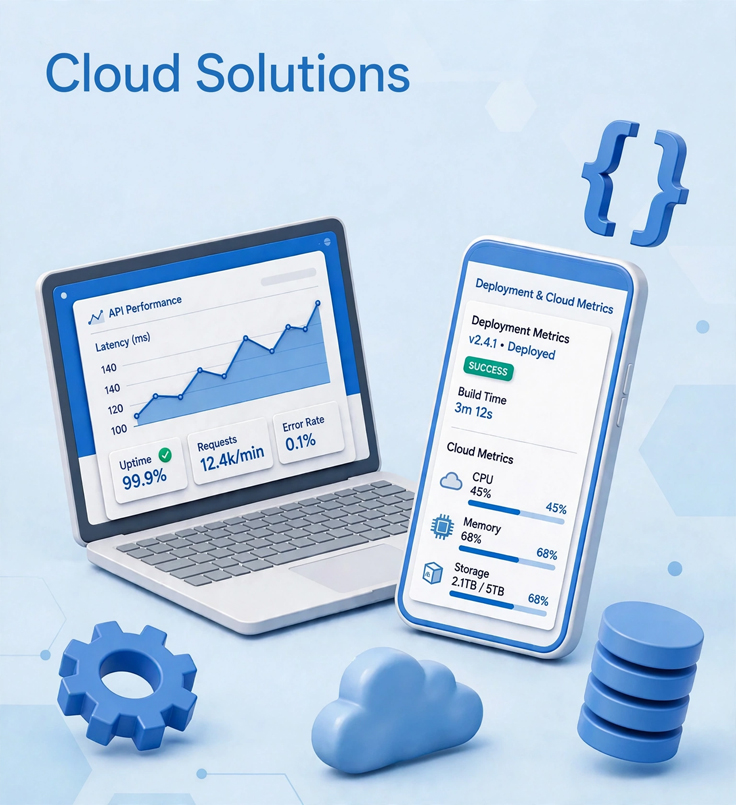
Cloud Solutions

Home > Cloud Solutions

Move Your Business to a Smarter Digital Infrastructure

Modern businesses depend on applications, databases, files, communication systems, and digital services every day. As those systems grow, managing infrastructure through traditional setups can become increasingly difficult.

Cloud Solutions provide a flexible way to run, store, manage, secure, and access digital resources without depending entirely on physical infrastructure.

Tamtech Technology helps businesses plan and implement cloud-based solutions according to their operational requirements. Whether you are moving an existing application to the cloud, setting up cloud infrastructure for a new system, improving backup and availability, or looking for a more scalable technology environment, we can help you select and implement an appropriate cloud approach.

Our focus is not simply on moving everything to the cloud. We focus on determining what should move, how it should move, where it should run, and how it should be managed afterward.

Cloud Technology That Supports Your Business

Cloud adoption should have a business reason behind it.

For some organizations, the priority may be reducing infrastructure dependency. For others, it may be easier remote access, better scalability, improved backup, higher availability, or the ability to launch applications faster.

Our Cloud Services can be structured around objectives such as:

  • Application hosting
  • Database hosting
  • Cloud migration
  • Infrastructure modernization
  • Backup and disaster recovery
  • Scalable computing resources
  • Remote business access
  • Application deployment
  • Cloud storage
  • System monitoring
  • Security and access management
  • Business continuity

The cloud environment is planned according to your application's technical requirements and business priorities.

Cloud Migration Services

Moving an existing system to the cloud requires more planning than simply transferring files from one server to another.

Before migration, we can assess the existing environment, including applications, databases, storage, dependencies, users, and connectivity requirements.

A migration project can involve:

Assessment
Planning
Architecture
Migration
Testing
Deployment
Monitoring

We aim to reduce disruption while ensuring that the migrated environment continues to support the required business operations.

Cloud migration can be considered for:

  • Existing business applications
  • Databases
  • Websites
  • Web applications
  • File storage
  • Internal software
  • Development environments
  • Reporting systems
  • Business platforms

Cloud Hosting for Business Applications

Your software needs an infrastructure environment that can support its users and workload.

Cloud hosting can provide computing, storage, networking, and other infrastructure resources without requiring the organization to maintain all physical hardware itself.

Tamtech Technology can help businesses plan cloud environments for:

  • Websites
  • Web applications
  • Business software
  • Business software
  • SaaS platforms
  • APIs
  • Customer portals
  • Mobile application backends
  • Internal management systems

The environment can be configured according to application requirements, expected traffic, data requirements, and future growth.

Scalable Cloud Infrastructure

Business workloads don't always remain constant.

An application may have a small user base today and significantly higher usage in the future. Seasonal demand, new branches, additional customers, or new products can also change infrastructure requirements.

Cloud infrastructure can provide greater flexibility to adjust resources according to changing workloads.

Depending on the architecture, resources such as:

  • Computing capacity
  • Storage
  • Database resources
  • Network resources
  • Application instances

can be planned for changing requirements.

This makes cloud infrastructure particularly useful for businesses expecting continued digital growth.

Cloud Backup & Disaster Recovery

A reliable backup strategy is an essential part of business continuity.

Hardware failure, accidental deletion, software problems, cyber incidents, or infrastructure failures can affect access to important business information.

Cloud-based backup and disaster recovery solutions can help organizations maintain additional copies of critical information and establish a recovery strategy.

A solution may include:

  • Automated backups
  • Database backups
  • Application backups
  • File backups
  • Backup retention
  • Recovery procedures
  • Off-site backup storage
  • Disaster recovery planning

The appropriate backup frequency and retention policy should be determined according to the importance and volume of the business data.

Cloud Database Solutions

Applications depend heavily on their databases. As data volume and user activity increase, database infrastructure needs to remain reliable and appropriately configured.

We can help businesses plan cloud environments for database-driven applications, including:

  • Business databases
  • Application databases
  • Reporting databases
  • Customer data
  • Transactional systems
  • SaaS databases

Database hosting can be planned alongside application infrastructure so that the application and its data environment work together efficiently.

Cloud Security & Access Management

Moving infrastructure to the cloud does not remove the need for security. It changes how security needs to be planned.

Cloud environments can be designed with controls around:

  • User authentication
  • Access permissions
  • Network access
  • Administrative privileges
  • Data protection
  • Application access
  • Backup security
  • Monitoring
  • Activity logging

Access should be provided according to the responsibilities of the user rather than giving every account unrestricted access to the environment.

Cloud Computing Services for Growing Businesses

Cloud computing can be particularly useful when a business wants technology infrastructure that can adapt as its requirements change.

Instead of making every infrastructure decision based on today's requirements, businesses can plan an environment that accommodates future changes.

Cloud solutions can support:

01
Startups

Launch applications without building a large physical infrastructure from the beginning.

02
Growing Businesses

Increase resources as users, transactions, and operations expand.

03
Established Organizations

Modernize legacy infrastructure and improve accessibility.

04
Software Companies

Host applications, APIs, databases, and SaaS platforms in flexible environments.

Cloud Solutions for SaaS & Software Platforms

Software companies often need infrastructure capable of supporting multiple customers, applications, databases, APIs, and changing workloads.

Tamtech Technology can help plan cloud infrastructure for software platforms with requirements such as:

  • Application hosting
  • Database infrastructure
  • API servers
  • Customer environments
  • Backup systems
  • Monitoring
  • Storage
  • Scalable computing
  • Secure administration

The infrastructure can be designed around the application's architecture and expected growth rather than adopting a fixed setup.

Connect Your Cloud With Your Existing Infrastructure

Cloud adoption doesn't necessarily mean abandoning everything you already have.

Some organizations need a combination of existing servers, office infrastructure, cloud systems, databases, and third-party platforms.

Where technically appropriate, cloud environments can be integrated with existing systems through suitable networking, APIs, databases, and application architecture.

This can support a gradual modernization strategy instead of requiring an immediate replacement of the entire technology environment.

Each user can be provided with the screens and functionality relevant to their role.

Cloud Monitoring & Maintenance

Launching a cloud environment is only the beginning.

Infrastructure needs to be monitored and maintained to identify potential problems, resource issues, configuration changes, and unusual activity.

Depending on the project, ongoing cloud management can include:

  • Infrastructure monitoring
  • Resource monitoring
  • Backup verification
  • Performance review
  • Storage management
  • Security configuration review
  • System updates
  • Resource optimization
  • Technical troubleshooting

Regular management helps keep the cloud environment aligned with changing business and application requirements.

Our Cloud Implementation Approach

We don't recommend a cloud architecture before understanding what you actually need.

Understand

We examine your current infrastructure, applications, databases, users, workloads, and business objectives.

Assess

We identify technical dependencies, infrastructure limitations, security considerations, and migration requirements.

Architect

We define an appropriate cloud environment based on workload, scalability, connectivity, storage, security, and budget considerations.

Implement

The required cloud resources and services are configured according to the agreed architecture.

Migrate

Applications, databases, files, and other selected resources are moved according to the migration plan.

Validate

The environment is tested to verify application functionality, connectivity, data availability, and required performance.

Go Live

The production environment is brought into operation with the required access and monitoring arrangements.

Manage

The environment can then be maintained, monitored, optimized, and expanded as requirements change.

Why Choose Tamtech Technology for Cloud Solutions?

01
Technology Based on Requirements

We don't treat every cloud project as identical. Infrastructure is selected according to your application and business requirements.

02
Migration With Planning

Existing applications and data are assessed before migration so dependencies and potential issues can be identified.

03
Application-Focused Infrastructure

The cloud environment is planned around the software that needs to run on it.

04
Security-Conscious Architecture

Access, permissions, data protection, and administrative controls are considered as part of the infrastructure design.

05
Built for Change

Cloud environments can be structured to accommodate increasing users, applications, data, and workloads.

06
Ongoing Technical Support

Cloud infrastructure can be monitored and maintained after implementation as your technology requirements evolve.

Is Cloud Right for Your Business?

Cloud technology can be valuable, but moving to the cloud simply because it is popular isn't necessarily the right strategy.

Cloud adoption may make sense when you need:

  • Flexible infrastructure
  • Remote accessibility
  • Faster application deployment
  • Scalable computing resources
  • Centralized infrastructure management
  • Improved backup capabilities
  • Reduced dependence on physical hardware
  • Support for growing workloads
  • Modernization of existing systems

The right approach depends on your applications, data, users, compliance requirements, budget, and operational model.

Frequently Asked Questions

Cloud solutions are technology services delivered through cloud infrastructure instead of relying entirely on locally managed physical systems. They can include application hosting, databases, storage, backup, computing resources, networking, security, and other infrastructure services.

Cloud Services can be used to host applications and websites, store information, run databases, create backup environments, support remote access, scale computing resources, and build modern digital infrastructure.

Yes. We can assess the application's architecture, database, dependencies, infrastructure, and migration requirements before recommending an appropriate migration approach.

In many cases, existing databases can be hosted or migrated to cloud infrastructure. However, compatibility, performance, licensing, connectivity, backup, and application dependencies should be evaluated before migration.

Cloud infrastructure can provide flexible resources that can be adjusted according to workload requirements. The actual scalability depends on how the application and infrastructure are architected.

Cloud security depends on architecture, configuration, access controls, application security, network design, data protection, monitoring, and how the environment is managed. Moving to the cloud does not automatically make a system secure.

Cloud backup can provide additional copies of important files, databases, or application data in a separate environment. A proper backup strategy should also define retention, recovery procedures, access controls, and backup verification.

Yes, depending on the technical environment. Hybrid architectures can connect cloud resources with existing infrastructure when networking, application, database, and security requirements allow it.

Cloud costs vary according to computing resources, storage, databases, bandwidth, backup requirements, software licensing, traffic, architecture, and usage patterns. We can help estimate infrastructure requirements based on the intended workload.

Yes. Support can include infrastructure monitoring, troubleshooting, backup management, configuration changes, optimization, maintenance, and assistance with future infrastructure requirements.

Build an Infrastructure That Can Keep Up

Your business infrastructure should not become a barrier to growth.

Whether you are moving an existing application to the cloud, launching a new software platform, improving your backup strategy, or looking for a more flexible hosting environment, Tamtech Technology can help you plan the right approach.

Book Demo