
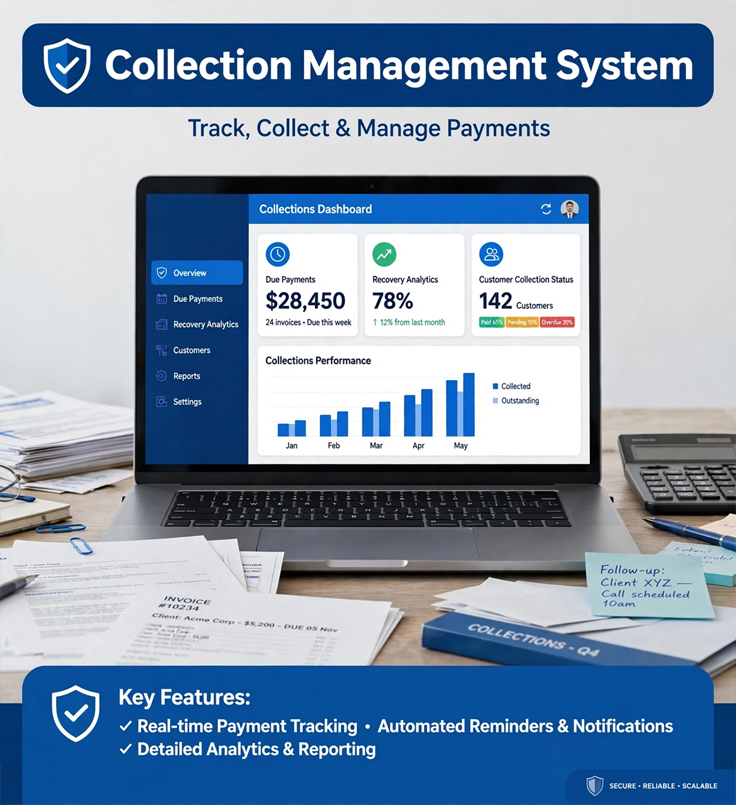
Collection Management System

Home > Collection Management System

Collection Management System for Efficient Loan & Field Collections

Managing collections becomes increasingly difficult when an organization handles thousands of customers, multiple branches, field executives, recurring payments, overdue accounts, and different loan products. Manual collection registers and spreadsheets can make it difficult to know who has paid, who is overdue, how much is outstanding, and how effectively field teams are performing.

Tamtech Technology Collection Management System is designed to bring customer collection activities into a centralized digital environment. It helps organizations organize collection schedules, assign accounts to collection executives, record payments, monitor overdue accounts, generate receipts, and track collection performance.

The system is suitable for businesses where regular customer payments, installment collections, field visits, and outstanding recovery are an important part of daily operations.

Turn Daily Collections into a Controlled Digital Process

Collection management is not simply about recording money received. An efficient collection operation needs coordination between customers, field executives, branch teams, accounts departments, and management.

A digital collection system can connect these activities into a structured workflow:

Customer
Due Account
Collection Assignment
Field Visit
Payment
Receipt
Account Update
Reconciliation
Management Report

This gives the organization a centralized view of collection activity and reduces dependency on manual records.

Who Can Use a Collection Management System?

Tamtech Technology's solution can be configured for different organizations that collect recurring payments from customers or members.

It can be useful for:

It can be useful for:

  • • NBFCs
  • Microfinance institutions
  • Finance companies
  • Loan providers
  • Credit societies
  • Cooperative societies
  • Thrift and credit organizations
  • Employee loan programs
  • Subscription-based collection businesses
  • Other organizations managing field collections

The workflow can be adapted according to the organization's collection model.

Collection Planning & Due Management

A collection operation starts with knowing which accounts are due.

The system can organize customer accounts according to payment schedules and help collection teams identify their daily or periodic collection requirements.

Collection lists can be prepared based on factors such as:

  • Due date
  • Customer
  • Area
  • Branch
  • Collection executive
  • Loan account
  • Payment amount
  • Overdue status

This enables collection managers to allocate work more systematically.

Daily Collection Dashboard

A centralized dashboard can provide management with an overview of collection operations.

Depending on the implementation, management can monitor:

  • Today's expected collection
  • Amount collected
  • Remaining collection
  • Number of customers visited
  • Pending collections
  • Overdue accounts
  • Executive-wise collection
  • Branch-wise performance
  • Collection efficiency

Instead of waiting for manual reports from different branches, authorized users can access current information from the system.

Field Collection Management

For organizations with doorstep or field-based collection, the collection executive is often the most important link between the customer and the organization.

A mobile-enabled collection system can provide field staff with relevant information before visiting customers.

Executives may be able to view:

  • • Assigned customers
  • • Due amounts
  • • Repayment schedules
  • • Customer contact information
  • • Previous payment history
  • • Outstanding balance
  • • Collection status

This allows field teams to organize their visits more efficiently.

Collection Route & Area Management

When collection executives cover specific geographic areas, organizing customers by location can improve field productivity.

The system can maintain customer and collection information according to areas, branches, territories, or assigned collection routes.

This can help managers distribute accounts among collection executives and reduce unnecessary duplication of field visits.

Where supported, location-based functionality can also provide additional visibility into field operations.

Mobile Collection Entry

A mobile collection application can allow field executives to record payments immediately after receiving them.

A typical process can be:

Select Customer
Select Account
Enter Payment
Confirm Transaction
Generate Receipt
Update Outstanding

This reduces the need to maintain handwritten records and enter the same payment again at the branch office.

The exact payment workflow can be configured according to the organization's operating procedure.

Digital Receipt Management

Providing customers with a proper payment acknowledgement is an important part of collection operations.

The system can support receipt generation for applicable transactions and maintain the corresponding receipt information with the customer account.

Depending on the implementation, receipts may be available in digital or printable formats.

This provides both the customer and organization with a reference for the transaction.

Cash & Digital Collection Tracking

Collection businesses may receive payments through different channels.

The system can maintain payment information according to the organization's supported collection methods, such as:

  • Cash
  • UPI
  • Bank transfer
  • Payment gateway
  • Other approved digital payment methods

Digital payment integrations can help automate payment confirmation and account updating where supported by the relevant provider.

Cash collections can be separately identified for reconciliation and branch-level settlement.

Automated Due & Outstanding Calculation

Manual calculation of customer dues becomes difficult when there are large numbers of accounts.

The collection system can calculate or display applicable outstanding amounts based on the underlying loan or account records.

Collection staff can view relevant information such as:

  • Current installment
  • Previous unpaid installment
  • Overdue amount
  • Principal outstanding
  • Interest
  • Applicable charges
  • Total payable amount

This helps field staff communicate accurate account information to customers.

Overdue Collection Management

Not every customer pays on the scheduled date.

An effective collection system should therefore provide a dedicated mechanism for managing overdue accounts.

Accounts can be categorized according to their payment status so that collection managers can prioritize follow-up activities.

Reports can identify:

  • Newly overdue accounts
  • Long-pending accounts
  • High-outstanding accounts
  • Repeatedly delayed accounts
  • Branch-wise overdue
  • Executive-wise overdue
  • Customer-wise overdue

This enables management to focus collection resources where they are most required.

Collection Follow-Up & Visit History

A collection attempt does not always result in immediate payment.

The system can maintain follow-up information related to customer visits and collection activities.

This can improve the accuracy of financial records and simplify periodic accounting review.

Authorized users can record relevant information such as:

  • Visit date
  • Collection attempt
  • Customer response
  • Payment status
  • Follow-up requirement
  • Next visit
  • Remarks

Maintaining a structured history prevents important collection information from being lost between field staff and office teams.

Collection Executive Performance

Management needs to know how effectively its collection team is performing.

The system can generate executive-level information such as:

  • Assigned collection
  • Actual collection
  • Pending collection
  • Number of customers handled
  • Number of successful collections
  • Overdue accounts
  • Follow-up activities

This can help managers identify operational gaps and compare collection activity against assigned responsibilities.

Performance metrics should be interpreted according to the organization's business model rather than relying on a single collection percentage.

Branch-Wise Collection Monitoring

For organizations operating multiple branches, collection information can be organized by location.

Head-office management can view consolidated information while branch managers can focus on their respective portfolios.

Branch-wise reporting can include:

  • Expected collection
  • Actual collection
  • Outstanding
  • Overdue accounts
  • Number of active customers
  • Collection executive performance
  • Daily transaction summary

This provides management with a clearer picture of collection performance across locations.

Customer Payment History

Every payment should contribute to a complete customer account history.

The system can maintain historical information covering:

  • Payment date
  • Amount
  • Payment method
  • Receipt number
  • Account
  • Outstanding balance
  • Collection executive
  • Transaction status

This allows authorized users to verify previous payments before discussing an account with a customer.

SMS & WhatsApp Collection Alerts

Automated communication can reduce the dependency on manual reminders.

Depending on the selected communication services, the system can send notifications for:

  • Upcoming payment
  • Due payment
  • Payment confirmation
  • Overdue amount
  • Collection reminders
  • Account updates
  • Important customer communication

SMS and WhatsApp functionality can be implemented through suitable third-party APIs.

Payment Gateway Integration

Organizations increasingly want customers to have the option to pay without waiting for a field executive.

A collection management platform can integrate with appropriate payment services to support online payments.

Possible workflows include:

Customer Receives Payment Request
Customer Pays Online
Payment Provider Confirms Transaction
System Updates Account
Digital Receipt

The actual payment options depend on the selected payment provider and its supported services.

eNACH& Recurring Payment Support

For organizations collecting recurring installments, electronic mandate services can help automate eligible payments.

Where required, the system can integrate with suitable eNACH or mandate service providers.

The platform can maintain relevant mandate information and process payment responses according to the configured workflow.

Implementation is subject to banking, payment-provider, customer authorization, and applicable regulatory requirements.

Collection Reconciliation

Recording a payment is only one part of the process. The organization must also reconcile collected amounts with its financial records.

The system can provide transaction information that assists teams in comparing:

Expected Collection
Recorded Collection
Deposited Amount
Accounted Amount

This can help identify discrepancies and simplify branch-level reconciliation.

Collection Agent Management

Organizations with large field teams need centralized control over collection assignments.

Administrators can organize collection executives and assign customers or accounts according to the operational structure.

Possible assignment criteria include:

  • Branch
  • Area
  • Territory
  • Product
  • Customer group
  • Collection route
  • Executive

This makes it easier to manage responsibility for individual accounts.

Collection Management for Microfinance

Microfinance organizations frequently operate with high-volume collections and geographically distributed customers.

A digital collection system can help manage:

  • Daily or weekly installments
  • Group collections
  • Individual borrower collections
  • Field executives
  • Due lists
  • Overdue accounts
  • Payment receipts
  • Collection reports

Mobile collection functionality can be particularly useful where staff regularly work outside the branch.

Collection Management for NBFCs

NBFCs managing large loan portfolios need accurate information about customer payments and overdue accounts.

A collection platform can connect with the organization's loan-management system to provide collection teams with current account information.

This allows the collection process to operate as part of the broader lending lifecycle rather than as a separate activity.

Collection Management for Credit & Cooperative Societies

A centralized system can connect member accounts with their payment schedules and collection records.

This can help societies reduce manual registers and provide better visibility into member-level transactions.

Collection Management Software with Loan Management Integration

Instead of maintaining separate customer and payment databases, collection transactions can be linked directly with loan accounts.

This creates a continuous information flow:

Loan Account
Due Schedule
Collection Assignment
Payment
Outstanding Update
Receipt
Accounting

Such integration reduces duplicate entry and helps maintain consistency between loan records and collection records.

Reports for Collection Managers

A collection management system should provide actionable reports rather than simply storing transactions.

Useful reports may include:

Daily Collection Report

Shows expected and actual collection for a particular day.

Due List

Identifies customers whose installments are due.

Overdue Report

Shows accounts where scheduled payments remain unpaid.

Executive Collection Report

Provides collection information for individual field executives.

Branch Collection Report

Compares collection activity across branches.

Customer Ledger

Shows the customer's payment and account history.

Outstanding Report

Provides information about remaining amounts.

Collection Reconciliation Report

Helps compare recorded transactions with collection/deposit information.

Customized reports can be developed according to organizational requirements.

Role-Based Access

Different employees require different levels of access.

Tamtech Technology can support role-based permissions for:

  • System Administrator
  • Head Office
  • Branch Manager
  • Collection Manager
  • Collection Executive
  • Accountant
  • Loan Officer
  • Management

This helps organizations control who can view, add, edit, approve, or report collection transactions.

Audit Trail & Transaction History

Financial transactions require traceability.

The system can maintain relevant transaction and activity information so authorized users can review collection entries and associated account changes.

An audit-oriented approach can help management investigate discrepancies and identify changes made during the collection process.

Data Security & Backup

Collection systems contain customer information and financial transaction data.

A production environment should therefore include appropriate measures for:

  • User authentication
  • Access control
  • Secure hosting
  • Database backup
  • Data recovery
  • Transaction monitoring
  • Document protection
  • Audit records

Tamtech Technology can provide software and technical infrastructure options according to the organization's requirements.

Benefits of a Digital Collection Management System

Moving collection operations to a centralized system can help organizations achieve several practical improvements:

Less Paperwork

Reduce dependence on handwritten collection registers.

Faster Updates

Record customer payments closer to the time of collection.

Better Visibility

Management can see collection activity through centralized reports.

Improved Accountability:

Assignments and collection transactions can be linked to responsible users.

Fewer Manual Calculations:

Use automated due, outstanding, and applicable charge calculations.

Better Customer Service:

Quickly access payment history and account information.

Improved Reconciliation:

Compare collection transactions with financial records.

Scalable Operations:

Manage increasing customers, branches, and collection executives through a centralized platform.

Why Tamtech Technology?

Tamtech Technology develops financial and business software focused on practical operational requirements.

Our Collection Management System can be implemented as a standalone collection platform or connected with existing loan-management, accounting, customer-management, and payment systems.

The solution can be adapted for organizations that require:

  • Web-based collection management
  • Mobile collection application
  • Customer payment tracking
  • Field executive management
  • Loan collection integration
  • Payment gateway integration
  • SMS and WhatsApp notifications
  • eNACH integration
  • Branch-wise reporting
  • Customized MIS
  • Role-based access
  • API-based integration

Frequently Asked Questions

A Collection Management System is software used to organize and monitor customer payment collection, field visits, due accounts, overdue accounts, collection executives, receipts, reconciliation, and collection reporting.

Yes. The system can manage loan installment collections and connect payment transactions with the relevant loan accounts.

Yes. A mobile collection application can be connected to the central system so field users can access assigned accounts and record collections.

Yes. Overdue accounts can be identified and organized through overdue lists, reports, follow-up records, and collection workflows.

Online payment functionality can be implemented through supported payment gateway and financial-service integrations.

Yes. API-based integration can be considered so that loan schedules, customer information, collection transactions, and outstanding balances can work together.

Yes. Tamtech Technology can develop customized reports and dashboards based on the organization's collection process and management requirements.

Make Collection Operations More Organized

An efficient collection operation requires accurate information, clear responsibility, timely follow-up, and reliable transaction records. When these activities are managed through disconnected registers and spreadsheets, operational complexity increases as the portfolio grows.

Tamtech Technology's Collection Management System provides a centralized technology platform for organizing customer dues, collection assignments, field activities, payments, receipts, overdue accounts, reconciliation, and management reporting.

It can work as a standalone collection solution or as part of a broader lending technology ecosystem connected with Loan Management, Accounting, Mobile Applications, Payment Gateways, eNACH, SMS, WhatsApp, and other financial APIs.

For organizations looking to modernize their field collection operations and gain better control over customer payments, Tamtech Technology provides a configurable platform designed around practical collection workflows.

Tamtech Technology – Digital Collection Management for Loans, Finance, Microfinance & Member-Based Organizations.

Book Demo